


Who are the Lost Tribes of Israel
&
Where did they go?
To answer the first question, it’s best to start with where the name Israel came from:
The name Israel first appears in the Bible in chapter 32 of Genesis. Jacob wrestled with an angel to get a blessing, and the angel ended up telling Jacob, “Your name shall no more be called Jacob, but Israel: for as a prince you have power with God and with men, and have prevailed.” Jacob and his family were referred to as Israel from that point forward, and his 12 sons (as well as their descendants) were referred to as the 12 tribes of Israel.
Throughout the Bible, God refers to Israel as His people (as do His Prophets & the Apostles of Jesus). In fact, while the phrases “God of the Gentiles, Italy, Greece, Chittim, Kittim, and/or heathen” never occur once in the Bible, the phrases “God of Shem, Abraham, Isaac, Jacob, the Hebrews, and/or your (Israel’s) fathers” appear almost 300 times!
As described in the Bible, the tribes of Israel became the lost tribes of Israel due to idolatry & following other gods. God Himself says that He is a jealous God and compares His people following other gods to an adulterous wife seeking other lovers.
What happened to the Tribes?
In chapter 11 of 1 Kings, it describes King Solomon having strange wives that turn his heart (and thereby Israel’s heart) away from God. Even though God had appeared to Solomon twice before warning him that his strange wives would turn his heart away from Him, Solomon disregarded the warnings and ended up burning incense and sacrificing to the gods of his strange wives. For this reason, God told King Solomon that he would rend the kingdom of Israel from his hand and give it to his servant Jeroboam. Solomon’s son, Rehoboam, was allowed to keep 2 tribes of Israel (Judah & Benjamin), and the other 10 tribes were given to Jeroboam.
In chapter 12 of 1 Kings, it describes the reigns of Rehoboam and Jeroboam, both of which reigned wickedly. Rehoboam was violent and wanted to bring the tribes of Judah and Benjamin to fight against their brothers (the other tribes of Israel), and Jeroboam led the people of Israel astray by practicing idolatry, making the most abase men priests, & ordaining false feast days. Therefore, it was violence & idolatry that ended up scattering the tribes of Israel.
Where did they go?
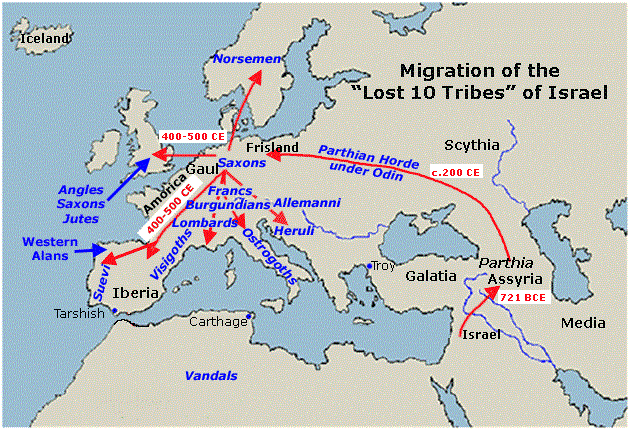
Since the people of Israel had turned their hearts away from God, He allowed them to be taken captive several times and they were then scattered throughout the surrounding regions, forgetting who they were over the course of history. The following map shows the migration of the lost tribes of Israel during the centuries before & after the arrival of Jesus:
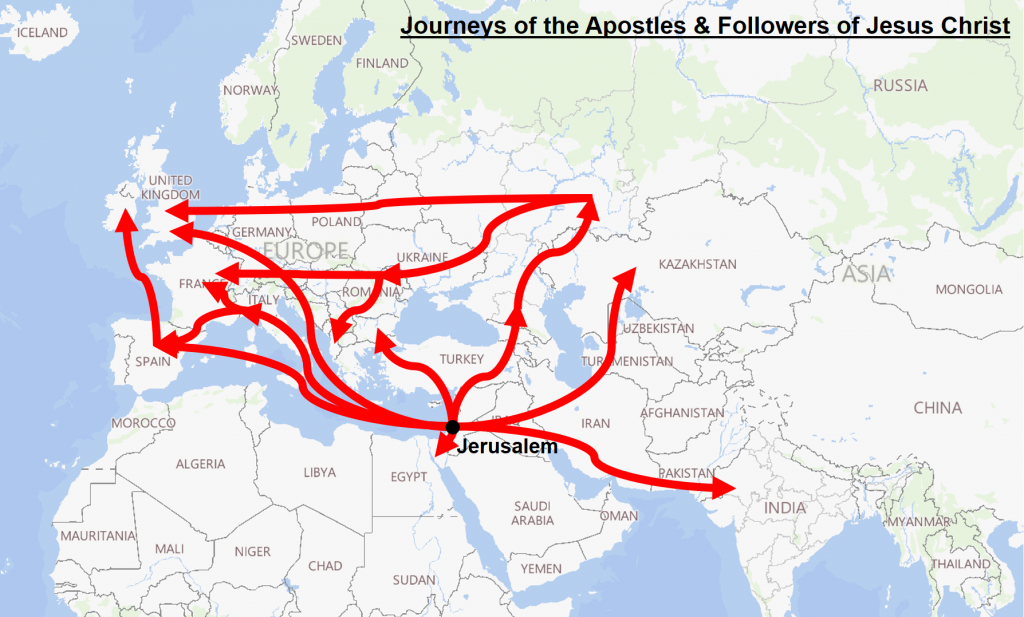
Once Jesus started teaching in the temple, he consistently told his Apostles to go after the lost tribes of Israel. After his death, that is exactly what they did. Not much detail is given in the canonized Bible regarding where the Apostles went; however, The Lost Chapter of Acts (chapter 29) gives an idea as to where the Apostles went by detailing where the Apostle Paul went.
The end of Acts in the canonized Bible is rather abrupt concerning the story of the Apostle Paul. The abrupt ending of Paul’s story has left many students & teachers of the Bible questioning what happened to Paul. By tradition, people have assumed Paul’s martyrdom in Rome was to be expected, but this is not specifically stated anywhere in the Bible. During the late 18th century AD, an ancient manuscript was unearthed and published which seemed to be the missing ending to the Book of Acts.
Acts 29:1-2 “And Paul, full of the blessings/purpose of Christ, and abounding in the Spirit, departed out of Rome, determining to go into Spain, … and was minded to go from there to Britain. (:2) For he had heard in Phoenicia that certain (“some people”) of the children of Israel, about the time of the Assyrian captivity, had escaped by sea to “The Isles/Coastlands afar off” as spoken by the Prophet [Esdra/Ezra], and called by the Romans – Britain.” (The Apocrypha, 2 Esdras 13:40-41)
Acts 29:3 “And the Lord commanded the gospel (“righteous message”) to be preached/proclaimed far hence to the Gentiles (“nations”), to the lost sheep of the House of Israel.” (Matt 10:5-6, 15:24)
Acts 29:4-7 “And no man hindered Paul; for he testified boldly of Jesus before the tribunes and among the people; and he took with him certain of the brethren which stayed with him at Rome, and… were brought safely into a haven (“port”) of Spain. (:5) And much people were gathered together from the towns and villages, … (:6) And Paul preached mightily in Spain, and great multitudes believed and were converted, for they perceived he was an Apostle sent from God. (:7) And they departed out of Spain, and Paul and his company finding a ship in Armorica sailing to Britain, they were therein, and passing along the South Coast, they reached a port called Raphinus (This is the Roman name for Sandwich, in Kent. In Saxon times there was, still standing in Sandwich, an old house called the “House of the Apostles” and tradition has it that Paul was one of the Apostles).”
Acts 29:8-9 “Now when it was voiced abroad that the Apostle had landed on their coast, great multitudes of the inhabitants met him, and they treated Paul courteously and he entered in at the east gate of their city, … (:9) And on the morrow (“next day”) he came and stood upon Mount Lud (St. Paul’s Cathedral stands near Ludgate Hill and Broadway in London, England) and the people thronged at the gate, and assembled in the Broadway, and he preached Christ to them, and they believed the Word and the testimony of Jesus.”
…
Acts 29:13 “And it came to pass that certain of the Druids came unto Paul privately, and showed by their rites and ceremonies they were descended from the Jews [Judahites] which escaped from bondage in the land of Egypt, …”
…
Acts 29:15 “And after these things Paul and his brethren departed from Raphinus (Kent, Britain) and sailed to Atium in Gaul (France).”
…
Acts 29:17-18 “And there came to him certain of the Belgae (those of Belgium) to enquire of him of the new doctrine, and of the man, Jesus, and Paul opened his heart unto them and told them all things that had befallen him, … (:18) And after much preaching and toil, Paul and his fellow labourers passed into Helvetia (modern Switzerland, the area bordering with France, Germany, Austria, & Italy), …”
…
Acts 29:26 “And they went forth and came to Illtricum (Illyricum, a Roman province spanning part of the Balkans, from modern Slovenia to modern Albania), intending to go by Macedonia (Greece) into Asia (region containing modern Ukraine, Russia, Turkey, and the Middle East), …”
So, in search of the Lost Tribes of Israel (as commissioned by Jesus), Paul went through the regions containing modern Turkey, Greece, Italy, Spain, Britain, France, Belgium, Germany, Switzerland, Austria, & the Balkans!
The other Apostles (excluding Judas Iscariot, who was replaced by Paul), along with Barnabas, Lazarus, & Mary Magdalene, are said to have gone to some of the same regions listed above as well as Scythia (Eastern Europe & Southern Russia) and regions containing modern Armenia, the Middle East, India, Russia, & the Caucasus Mountains.
God has said that He will gather His people that have been scattered. He knows that they have been oppressed by violent, idolatrous rulers who have turned their hearts away from Him. However, if they turn their hearts again toward Him, then God promises that He will gather His people together before His Wrath is poured out on the world in the great Day of Judgment.
The Book of the Prophet Jeremiah
(Words that the Lord spoke concerning Israel and concerning Judah)
Jer 30:7 “Alas! for that Day will be great, so that none is like it: it is even the time of Jacob’s (Israel’s) tribulation; but he shall be saved/delivered out of it.”
Jer 30:8 “For it shall come to pass in that Day, says the Lord of hosts, that I will break his (Babylon’s) yoke from off your neck, and will burst your bonds, and strangers/adulterers shall no more enslave him (Jacob/Israel):”
Jer 30:9 “But they shall serve the Lord their God, and [the one of] David their king, whom I will raise up unto them.”
Jer 30:10 “Therefore fear not, Oh My servant Jacob (Israel), says the Lord; neither be dismayed, Oh Israel: for, lo, I will save/deliver you from afar, and your seed from the land of their captivity; and Jacob (Israel) shall return, and shall be in rest, and be at ease, and none shall make him afraid.”
Jer 30:11 “For I am with you, says the Lord, to save/deliver you: though I will make a full end of all nations/heathen where I have scattered you, yet will I not make a full end of you: but I will correct you in the Law, and will not leave you altogether unclean (“cut off”).”